Boundaries Aren't Walls: Why Your Nervous System Needs Guardrails to Feel Safe
If you've ever struggled to set boundaries, you've probably heard some version of this fear:
"I don't want to hurt their feelings."
"I don't want to seem selfish."
"What if they get upset with me?"
Many people think boundaries are about controlling other people's behavior or keeping people at a distance. In reality, healthy boundaries are neither walls nor ultimatums.
They're guardrails that help create safety, clarity, and connection—both in your relationships and within your nervous system.
As a Registered Associate Marriage and Family Therapist, I've noticed that many people who struggle with anxiety, burnout, people-pleasing, or relationship difficulties aren't lacking kindness or empathy.
In fact, they're often incredibly caring. The problem is that they've learned to prioritize other people's comfort at the expense of their own well-being.
Over time, this can leave the nervous system stuck in a chronic state of stress.
The good news?
Boundaries aren't just relationship skills. They're nervous system skills.

Why Boundaries Feel So Difficult
Most people know what a boundary is intellectually. The challenge is implementing one when emotions get involved.
Imagine you've had a long week. You're exhausted and desperately need rest. Then a friend asks for a favor that would require several hours of your time.
Logically, you know it's okay to say no.
Yet your body might tell a different story.
Your stomach tightens.
Your chest feels heavy.
Your mind races.
You begin rehearsing explanations and apologies.
Why?
Because for many people, boundary-setting doesn't feel safe.
Our nervous systems learn from experience. If you grew up in an environment where expressing needs was criticized, ignored, punished, or met with conflict, your body may have learned that self-protection comes with consequences.
As a result, saying "no" can feel surprisingly similar to danger—even when no actual threat exists.
This is one reason why people often continue overcommitting themselves despite knowing it's unsustainable.
The issue isn't a lack of information.
It's a lack of nervous system safety.
What Happens When We Ignore Our Boundaries
When we consistently override our own needs, our nervous system receives an important message:
"My needs aren't important."
At first, this may look harmless.
You stay late at work.
You answer emails after hours.
You agree to plans you don't want to attend.
You tolerate behavior that leaves you feeling resentful.
But eventually, the body begins keeping score.
Research suggests that chronic stress can contribute to emotional exhaustion, anxiety, difficulties with emotional regulation, and physical health concerns.
When our boundaries repeatedly erode, our nervous system often remains activated for longer periods of time than it was designed to.
You might notice:
Increased anxiety
Irritability
Difficulty sleeping
Emotional overwhelm
Resentment toward others
Feeling disconnected from yourself
Chronic fatigue or burnout
Many people mistakenly believe these symptoms mean they're "too sensitive."
In reality, they may be signs that their nervous system is asking for clearer limits.
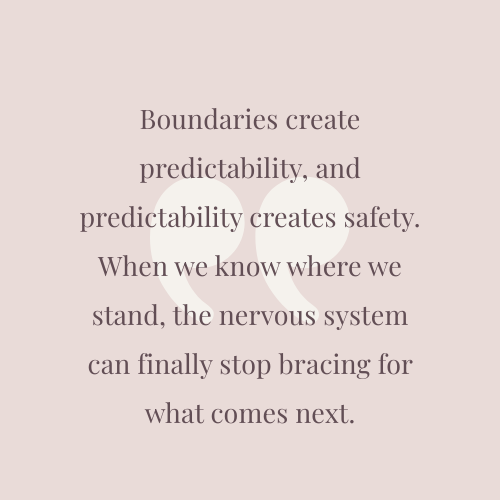
Boundaries Create Predictability
One of the nervous system's primary jobs is determining whether we're safe.
Interestingly, safety isn't simply the absence of danger.
Safety is also predictability.
When expectations are unclear, the brain works overtime trying to anticipate what might happen next.
Consider two workplaces:
In one workplace, expectations are vague, communication is inconsistent, and employees never know when they'll be contacted.
In the other workplace, expectations are clearly communicated and employees know when they are and aren't available.
Which environment feels calmer?
Most people would choose the second.
Boundaries create predictability in much the same way.
They help define where responsibilities begin and end.
They clarify expectations.
They reduce uncertainty.
And uncertainty is often fuel for anxiety.
Boundaries Strengthen Relationships
One of the biggest myths about boundaries is that they push people away.
Healthy boundaries often do the opposite.
Without boundaries, relationships can become filled with hidden resentment, unspoken expectations, and emotional exhaustion.
You say yes when you mean no.
You suppress your feelings.
You silently hope others will notice your discomfort.
Over time, frustration builds.
Eventually, the relationship suffers.
Boundaries allow people to interact honestly.
Instead of pretending, you communicate.
Instead of mind-reading, you clarify.
Instead of resentment, you create transparency.
Research on relationship functioning consistently shows that healthy communication and emotional regulation contribute to stronger, more satisfying relationships. Boundaries support both.
The healthiest relationships aren't those without conflict.
They're the ones where people can express their needs safely and respectfully.
The Connection Between Boundaries and Self-Worth
Many people think boundaries are communication skills.
They're also self-worth skills.
Every boundary sends a message.
When you consistently abandon your needs, the message becomes:
"Other people's needs matter more than mine."
When you honor your limits, the message shifts:
"My needs matter too."
Notice the difference.
Not more.
Not less.
Too.
Healthy boundaries aren't about becoming rigid, demanding, or self-focused.
They're about recognizing that your needs deserve consideration alongside everyone else's.
This balance helps cultivate a stronger sense of self-trust.
And self-trust is one of the foundations of emotional well-being.

How to Start Building Nervous System-Friendly Boundaries
If boundaries feel uncomfortable, start small.
Remember: the goal isn't perfection.
The goal is helping your nervous system learn that expressing your needs can be safe.
Try these steps:
1. Notice Your Body's Signals
Before setting boundaries externally, begin noticing your internal signals.
Ask yourself:
What situations leave me feeling drained?
When do I feel resentful?
What requests do I immediately want to say no to?
Your body often recognizes a boundary violation before your mind does.
2. Pause Before Responding
Many people-pleasers answer immediately.
Instead, try:
"Let me check my schedule and get back to you."
This creates space for a thoughtful response rather than an automatic one.
3. Start With Low-Risk Boundaries
Practice in situations that feel manageable.
You might decline an invitation, request additional time, or communicate a preference.
Small successes help build nervous system confidence.
4. Expect Discomfort
Feeling uncomfortable doesn't mean you're doing something wrong.
It often means you're doing something new.
Your nervous system may need time to learn that healthy limits don't equal rejection or danger.
5. Stay Consistent
Boundaries work best when they are clear and consistent.
You don't need lengthy explanations or elaborate justifications.
A simple, respectful statement is often enough.
Boundaries as an Act of Self-Compassion
At its core, boundary-setting is an act of self-compassion.
It's recognizing that your energy is finite.
Your emotions matter.
Your needs deserve attention.
And your nervous system functions best when it isn't constantly sacrificing itself to maintain harmony.
Boundaries aren't walls designed to keep people out.
They're guardrails that help you stay connected to yourself while remaining connected to others.
When we understand boundaries through the lens of nervous system health, they stop feeling selfish.
Instead, they become a form of care.
Care for your relationships.
Care for your emotional well-being.
And care for the part of you that deserves to feel safe.
Ready to Build Healthier Boundaries?
If anxiety, people-pleasing, burnout, or childhood experiences make it difficult to advocate for your needs, therapy can help.
Together, we can explore the roots of these patterns, strengthen your self-trust, and develop practical tools for creating boundaries that support both emotional and nervous system health.
If you're located in Los Angeles or anywhere in California, I offer individual therapy and couples counseling both in person and via secure telehealth.
Contact me today to schedule a consultation and begin building relationships that feel more balanced, authentic, and sustainable.
References
Mikulincer, M., & Shaver, P. R. (2019). An attachment perspective on psychopathology. World Psychiatry, 18(1), 25–26.