Why You Can't Relax: When Productivity Becomes Your Identity
You finally sit down after a long day.
The emails have been answered. The dishes are done. The work project is complete.
Yet instead of feeling relaxed, you feel uneasy.
Your mind immediately searches for the next task. Maybe there's something you forgot. Maybe there's something else you should be doing. Maybe you haven't done enough today.
If this sounds familiar, you're not alone.
Many people assume that productivity is simply a personality trait or a sign of ambition. While ambition can certainly be healthy, some people discover that their drive to stay productive runs much deeper. What looks like motivation from the outside may actually be fueled by anxiety, perfectionism, or a deeply held belief that their worth depends on what they accomplish.
In therapy, I often hear clients describe a constant pressure to perform, achieve, and stay busy. They aren't necessarily trying to be successful because they enjoy the work. Instead, they feel compelled to keep moving because slowing down feels uncomfortable—or even unsafe.
When productivity becomes part of your identity, rest can feel surprisingly difficult.

When Being Productive Becomes Who You Are
Productivity is a useful tool. It helps us accomplish goals, care for responsibilities, and create meaningful change in our lives.
The problem arises when productivity becomes more than something you do and starts becoming who you are.
You may notice this if:
You feel guilty when resting.
You struggle to enjoy downtime.
Your mood depends on how much you accomplished that day.
You frequently compare your output to others.
You feel anxious when your schedule isn't full.
You tie your sense of value to achievement.
Over time, productivity stops serving your life and begins driving it.
Rather than asking, "What matters most to me?" you may find yourself asking, "What should I be doing next?"
The distinction may seem subtle, but it can have a significant impact on mental health and overall well-being.
Healthy Ambition Versus Achievement-Based Self-Worth
There is nothing wrong with setting goals, working hard, or striving for excellence.
Healthy ambition is often rooted in values. You pursue goals because they align with what matters to you. Success feels rewarding, but it doesn't determine your worth as a person.
Achievement-based self-worth works differently.
When self-worth becomes dependent on performance, accomplishments become evidence that you're enough. As a result, mistakes feel devastating, criticism feels personal, and success provides only temporary relief.
You may find yourself constantly chasing the next milestone, believing that the next achievement will finally bring a lasting sense of satisfaction.
Unfortunately, that feeling rarely arrives.
The promotion leads to a new goal.
The completed project is replaced by another deadline.
The accomplishment briefly quiets the inner critic before it starts demanding more.
Productivity as a Defense Mechanism
Sometimes productivity serves a purpose beyond getting things done.
For some individuals, staying busy can function as a way to avoid difficult emotions or experiences.
When life slows down, uncomfortable feelings often become more noticeable. Anxiety, loneliness, grief, uncertainty, shame, or self-doubt may rise to the surface.
Busyness can provide temporary relief from these emotions.
If every moment is occupied by work, errands, responsibilities, or goals, there is little space left to reflect on how you're actually feeling.
This doesn't mean productivity is inherently unhealthy. Rather, it invites an important question:
"What happens when I stop?"
For many people, the answer reveals valuable information about their relationship with achievement and self-worth.
Where These Patterns Often Begin
Our relationship with productivity is rarely created overnight.
Many high-achieving adults grew up receiving praise for being responsible, successful, helpful, or accomplished. Others learned that making mistakes led to criticism or disappointment.
Some individuals discovered that achievement created a sense of stability during stressful or unpredictable periods of life.
Without realizing it, they developed an internal message:
"I am valuable because of what I do."
This belief can become deeply ingrained.
In adulthood, it often appears as perfectionism, overworking, difficulty setting boundaries, or a persistent fear of falling behind.
What once served as a protective strategy may eventually contribute to emotional exhaustion.
The Connection Between Perfectionism and Burnout
Burnout is often viewed as the result of working too much. While excessive demands certainly play a role, the internal relationship we have with work also matters.
Research has shown that perfectionistic tendencies are associated with greater vulnerability to burnout and psychological distress (Angelini, 2023). When individuals place intense pressure on themselves to meet exceptionally high standards, everyday challenges can become chronic sources of stress.
Perfectionism often convinces people that they must do more, achieve more, or be more before they can feel satisfied.
The problem is that perfection has no finish line.
There is always another improvement to make, another task to complete, or another way to optimize performance.
Over time, this relentless pressure can become exhausting.
The Hidden Cost of Constant Productivity
Many high achievers appear successful on the outside while quietly struggling on the inside.
They may receive praise from coworkers, friends, and family members for their dedication and reliability. Yet internally, they feel depleted.
Recent research examining workaholic tendencies found associations with emotional exhaustion, sleep disturbances, and physiological indicators of stress (Menghini & Balducci, 2024). In other words, when people feel compelled to work excessively, the costs often extend beyond mental health and begin affecting physical well-being as well.
Some common signs include:
Difficulty disconnecting from work
Feeling restless during downtime
Persistent fatigue
Irritability
Sleep difficulties
Trouble being present with loved ones
Feeling that nothing you accomplish is ever enough
These signs are often easy to dismiss because productivity is highly valued in our culture.
However, being productive and being well are not always the same thing.
Why Rest Feels Uncomfortable
If your identity has become intertwined with achievement, rest may trigger unexpected anxiety.
Without the reassurance that comes from accomplishing tasks, old fears can emerge.
You might notice thoughts such as:
I'm wasting time.
I should be doing something productive.
Everyone else is getting ahead.
I'm falling behind.
I haven't earned this break.
Many people interpret these thoughts as evidence that they need to work harder.
In reality, they may be signs that self-worth has become overly dependent on performance.
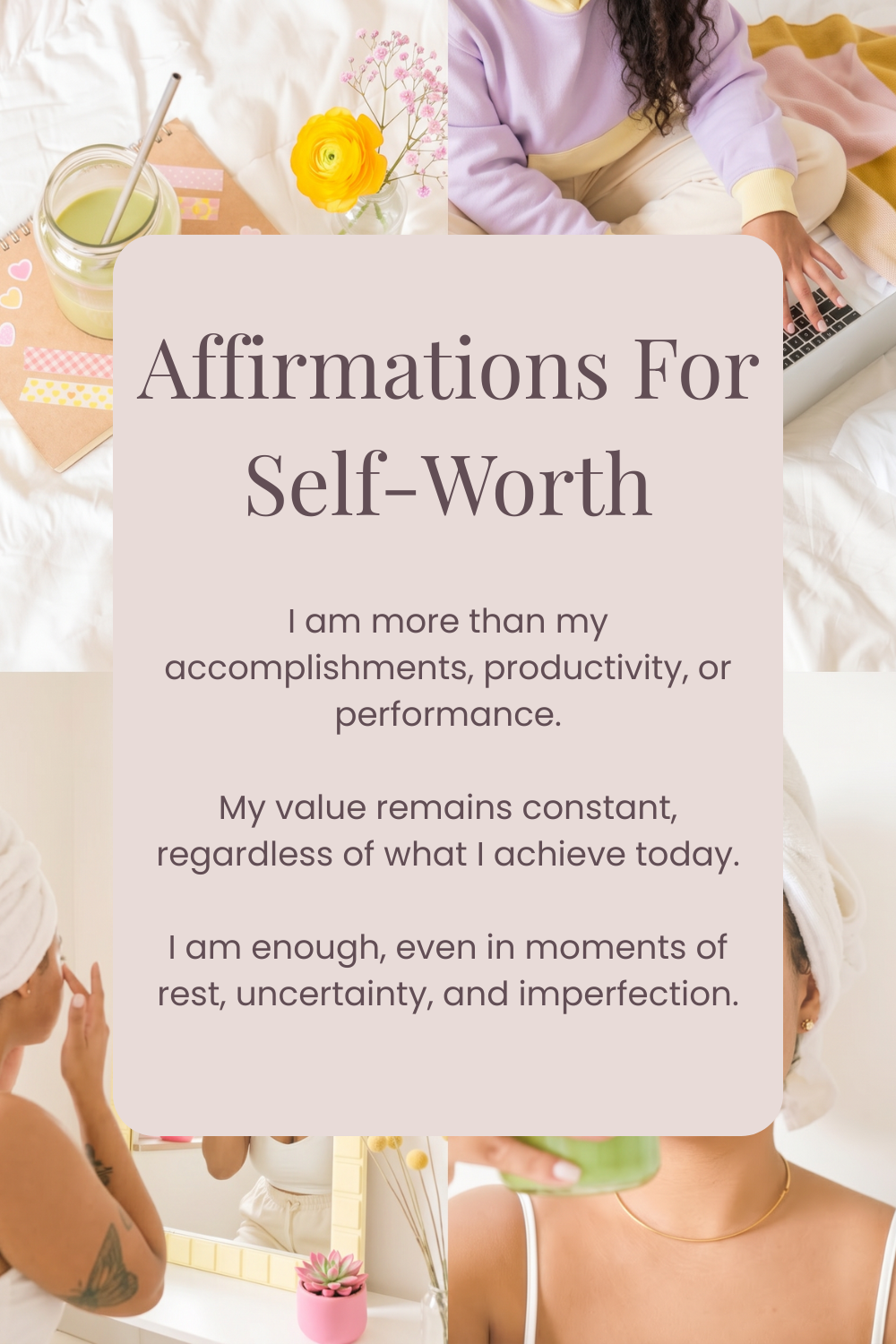
Learning to rest often requires learning that your value does not disappear when you stop producing.
Building a More Sustainable Relationship with Achievement
The goal is not to eliminate ambition.
The goal is to create a healthier relationship with it.
You can continue pursuing meaningful goals while recognizing that your worth exists independently of your accomplishments.
Consider reflecting on the following questions:
What qualities do I value about myself that have nothing to do with achievement?
Who am I when I'm not working?
What activities bring me joy rather than a sense of accomplishment?
What would change if I believed I was already enough?
How do I want to feel, not just what do I want to achieve?
These questions help shift attention away from constant performance and toward a broader sense of identity.

A Different Definition of Success
What if success included more than productivity?
What if it also included:
Meaningful relationships
Time for rest
Emotional well-being
Creativity
Play
Personal growth
Alignment with your values
These experiences may not show up on a to-do list, but they are often the very things that make life feel fulfilling.
Achievement can certainly be part of a meaningful life.
It simply doesn't need to be the measure of your worth.
You Don't Have to Carry It Alone
If you recognize yourself in these patterns, therapy can provide a space to explore where they began, how they may be serving you, and what it might look like to build a healthier relationship with achievement, rest, and self-worth.
At Olive & Fig Counseling, we help individuals move beyond survival mode and reconnect with a life guided by values rather than pressure.
If you're ready to explore a more sustainable path forward, contact us to schedule a consultation and learn how therapy can support your journey toward greater balance, self-compassion, and well-being.
References:
Angelini, G. (2023). Big five model personality traits and job burnout: A systematic literature review. BMC Psychology, 11(49). https://doi.org/10.1186/s40359-023-01056-y
Menghini, L., & Balducci, C. (2024). The daily costs of workaholism: A within-individual investigation on blood pressure, emotional exhaustion, and sleep disturbances. Journal of Occupational Health Psychology, 29(4), 201–219. https://doi.org/10.1037/ocp0000383