The Unseen Psychology of Burnout (And How to Rebuild)
It starts with a silence that feels slightly too heavy.
Elena sat in her car outside her office building at 7:45 AM. The ignition was off, the engine was cold, and her hands were clamped around the steering wheel like a life preserver.
For twenty minutes, she had been staring at the third-floor window of her department, completely unable to open the car door.
She wasn’t lazy. She wasn’t unmotivated. In fact, Elena was the person who routinely volunteered for late-stage project reviews, mentored junior colleagues, and answered emails at 10:30 PM.
Yet, on this ordinary Tuesday morning, her mind felt like an engine turning over without fuel—a loud, metallic grinding sound, followed by absolute static.
Her heart wasn't racing with acute panic; rather, her chest felt hollowed out, as if her internal resources had been systematically siphoned away over months, leaving behind a brittle shell.
As an Associate Marriage and Family Therapist I see versions of Elena every week in my practice. They come in believing they have failed a personal endurance test. They apologize for "losing their edge" or "not having enough discipline."
The first thing I tell them is this: Burnout is not a character flaw. It is a biological and psychological adaptation to prolonged, unmitigated stress.
What Is Burnout? (Beyond the Buzzword)
We use the word "burned out" casually to describe a exhausting week or a brutal deadlines sprint.
But true clinical burnout—recognized by the World Health Organization as an occupational phenomenon—is a distinct psychological syndrome characterized by three core dimensions:
Emotional Exhaustion: A profound depletion of energy reserves that sleep alone cannot fix.
Depersonalization (or Cynicism):A protective emotional detachment from work, clients, or daily responsibilities, often accompanied by irritation or apathy.
Reduced Personal Accomplishment: A growing sense of inadequacy, self-doubt, and inefficiency, where even small wins feel meaningless.
When you experience burnout, your nervous system has spent months—or years—operating in an elevated threat state.
Your hypothalamic-pituitary-adrenal (HPA) axis, which regulates your body’s stress response, becomes dysregulated.
Over time, high cortisol output gives way to a paradoxical state of "hypocortisolemia" or extreme blunting, leading to chronic fatigue, cognitive fog, and emotional numbness.
Researchers studying occupational psychology emphasize that burnout arises when there is a chronic mismatch between an individual's personal resources and their environment's demands (Demerouti et al., 2021).
The Path to Burnout: How High Achievers Slide Into Depletion
Burnout rarely happens overnight. It creeps in through subtle, socially praised behaviors.
In my practice, I often observe a recurring four-stage progression:
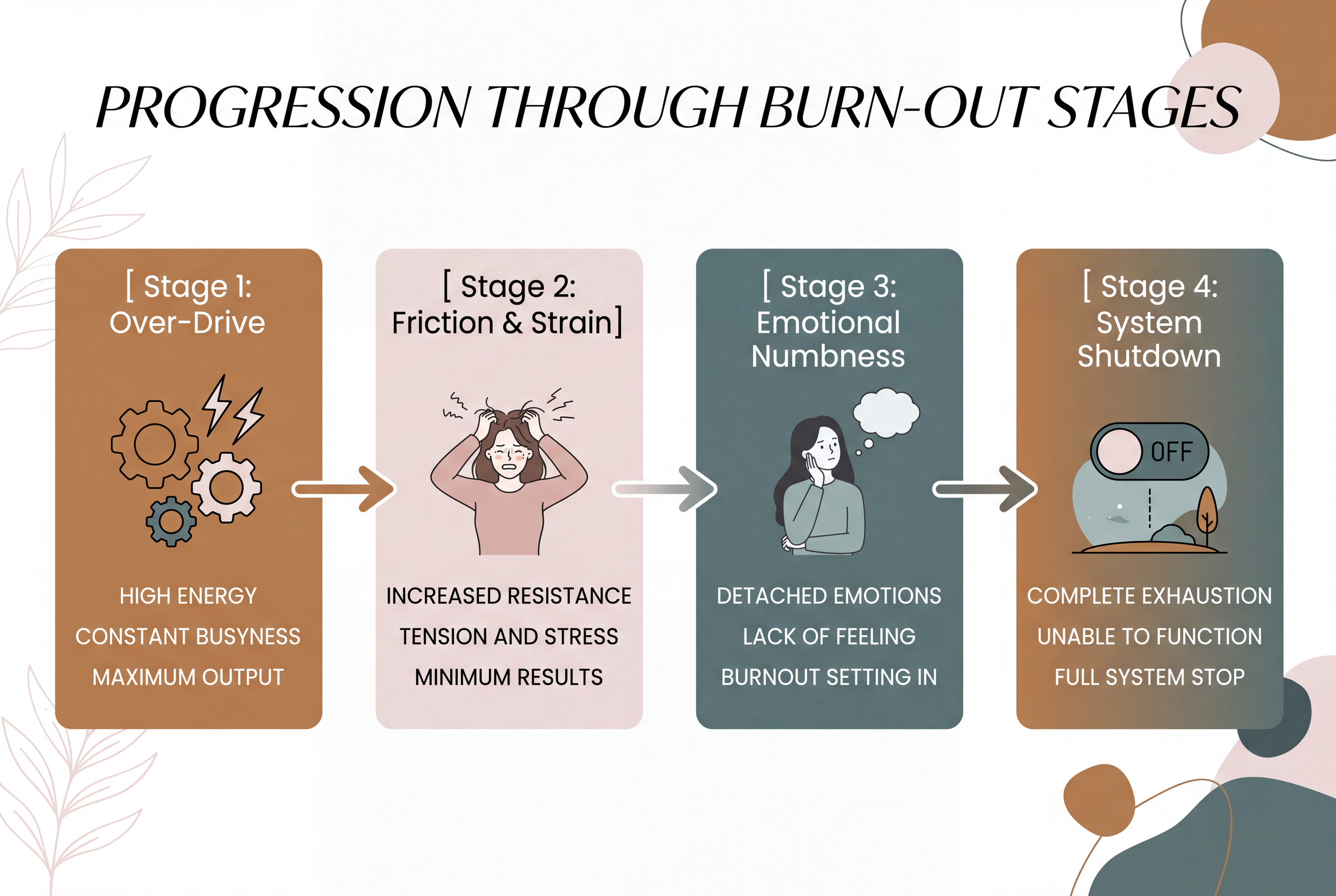
Burnout Stages
1. Over-Drive (The Honeymoon of Overworking)
You take on new projects with high ambition. You sacrifice boundaries, skip lunch breaks, and derive your self-worth almost exclusively from productivity and externally validated achievement.
2. Friction & Strain
The sheer volume of demands begins to outstrip your energy. You notice early physical warnings: tension headaches, jaw clenching, sleep disturbances, or a persistent feeling of being rushed. You push through using caffeine, sheer willpower, or self-criticism.
3. Emotional Numbness & Cynicism
To protect yourself from ongoing overwhelm, your psyche implements a survival strategy: detachment. You stop caring as deeply about outcomes. You become cynical about your team, your organization, or your personal goals.
4. System Shutdown
This was Elena’s car-park moment. The body and brain hit an emergency circuit breaker. Cognitive function drops, executive decision-making falters, and basic tasks feel insurmountable.
The Scientific Framework: Demands vs. Resources
To understand why burnout happens, organizational psychologists rely heavily on the Job Demands-Resources (JD-R) Model (Sainio et al., 2022).
This framework splits any role or lifestyle into two categories:
Demands:Aspects of a job or life that require sustained physical, mental, or emotional effort (e.g., tight deadlines, high emotional labor, ambiguous expectations, toxic communication).
Resources:Physical, psychological, social, or organizational assets that help achieve goals and reduce psychological costs (e.g., peer support, autonomy, clear boundaries, adequate rest, alignment with personal values).
Burnout occurs when demands consistently outstrip resources over a long duration without adequate recovery windows.
If you attempt to fix burnout simply by practicing "self-care"—like taking a bubble bath or using a mindfulness app on Sunday evening—without modifying the underlying imbalance between demands and resources, the underlying engine remains broken.
5 Practical Steps to Recover from Burnout
Recovering from burnout is not a weekend project. It requires an intentional, multi-layered restructuring of your daily life, your environment, and your relationship with achievement.
1. Complete the Stress Response Cycle
Experiencing a stressor (like a difficult email) triggers a physiological reaction in your body. Removing the stressor (closing your laptop) does not automatically end the physiological state.
To tell your nervous system that it is safe, you must physically complete the stress cycle:
Physical Movement:A brisk 20-minute walk, stretching, or dancing.
Deep Somatic Breathing:Exhalations longer than inhalations (e.g., box breathing or physiological sighs).
Social Connection:A warm 20-second hug or an authentic conversation with a trusted friend.

2. Perform a "Demands Audit"
Take a piece of paper and divide it into two columns: Demands andResources.
List everything currently consuming your psychological energy. Identify at least two demands you can immediately:
Delegate:Pass tasks to others or share responsibility.
Eliminate:Stop doing low-impact tasks that stem purely from perfectionism.
Tolerate lower standards for: Move from "perfect" to "good enough" on routine tasks.
3. Restore Autonomy Through Micro-Boundaries
Loss of control is a primary driver of depersonalization. Reclaim agency by establishing strict, non-negotiable micro-boundaries:
Set a hard end time for work each day.
Turn off non-essential notifications after 6:00 PM.
Create a 15-minute "transition buffer" between work and home life where no tasks are permitted.
4. Shift from Self-Criticism to Compassionate Self-Proof
When burned out, your inner critic often doubles down:
"Why are you so weak? Other people handle this easily."
Psychological research shows that self-compassion, rather than self-criticism, enhances psychological resilience and lowers physiological distress.
Acknowledge your current state without judgment:
"My body is slowing me down because it has been protecting me under high stress for a long time."
5. Reconnect with Low-Stakes Joy
Burnout strips away your sense of play. Recovery requires engaging in activities where there is no performance metric, no audience, and no output required.
Consider tactile, low-stimulus activities: gardening, simple woodworking, journaling, walking in nature, or listening to music without multi-tasking.
Rebuilding After the Break
Three months after her morning in the car park, Elena’s life looked different—not because she changed careers entirely, but because she changed her operational framework.
She established firm boundaries on her availability, communicated her workload capacity directly to leadership, and prioritized physiological recovery over constant availability.
Most importantly, she stopped viewing her energy as an infinite resource that could be extracted indefinitely.
Burnout is painful, but it can also serve as a crucial diagnostic signal. It is your system's way of informing you that the rules you are currently operating by are no longer sustainable.
Listening to that signal isn't a sign of weakness—it is the first step toward long-term psychological health and sustainable achievement.
If you recognize yourself or your team in Elena’s story, know that you don't have to navigate the path back from depletion alone.
Recovering from burnout requires more than just standard advice; it takes a tailored, science-backed approach to rebuild your energy, reset your boundaries, and restore your sense of purpose.
Book a complimentary consultation call with our team today.
Together, we will assess your current demands, identify your high-impact stressors, and construct a personalized, actionable recovery plan so you can move from surviving day-to-day to thriving again.
References
Demerouti, E., Bakker, A. B., Peeters, M. C. W., & Breevaart, K. (2021). New directions in burnout research. European Journal of Work and Organizational Psychology, 30(5), 686–691. https://doi.org/10.1080/1359432x.2021.1979962 Cited by: 423
Sainio, M., Hämeenaho, P., Rönkkö, M., Nurminen, T., Torppa, M., Poikkeus, A.-M., Merjonen, P., & Aro, T. (2022). Interpersonal work resources and school personnel well-being before and after lockdown during the first phase of the COVID-19 pandemic in Finland. Teaching and Teacher Education: Leadership and Professional Development, 1, 100013. https://doi.org/10.1016/j.tatelp.2022.100013